St. Paul St. Paul's University

ST. PAUL'S UNIVERSITY The University of Choice!

  • Staff Portals
    • Staff Portal
    • CAD Portal
  • Student Portals
    • Students Portal
    • E-learning Portal
    • TVET E-learning
    • Exam Portal
  • Alumni
  • TVET
  • Library
  • EACA Conference
  • Research
  • Tender
    • Portal
  • Blog
  • Home
  • About Us
    • History
    • Vision, Mission and Philosophy
    • Core Values and Objectives
    • Governance
      • Chancellor
      • Board of Trustees
      • University Council
      • University Management Board
      • University Senate
    • Facilities and Amenities
      • SPU Enterprise Unit
      • SPU Health Services
    • Directorates
      • Research
      • Board of Postgraduate Studies
      • Virtual Campus
      • Quality Assurance
    • Campuses
      • Nairobi Campus
      • Nakuru Campus
      • Virtual Campus
    • Partnerships
    • Careers
    • Scholarship
  • Academics
    • Academic Programmes
    • Schools
      • Theology
      • Education & Social Sciences
      • Business & Leadership Studies
      • Health Sciences
      • Communication & Computer Studies
  • Admissions
    • Admission Regulations
    • Government Sponsored students
    • Refer a Friend and Earn an SPU Reward
  • Students Life
  • Resources
  • SPU News
  • Contact Us
  • Staff and Students Resources
  • Staff Portals +
    • Staff Portal
    • CAD Portal
  • Student Portals +
    • Students Portal
    • E-learning Portal
    • TVET E-learning
    • Exam Portal
  • Alumni
  • TVET
  • Research
  • Library
  • Journals

Apply Now!

Marketplace Transformation webinar
Featured

St. Paul’s University to Host Webinar on "Marketplace Transformation"

SPU Admin Blog 21 October 2026

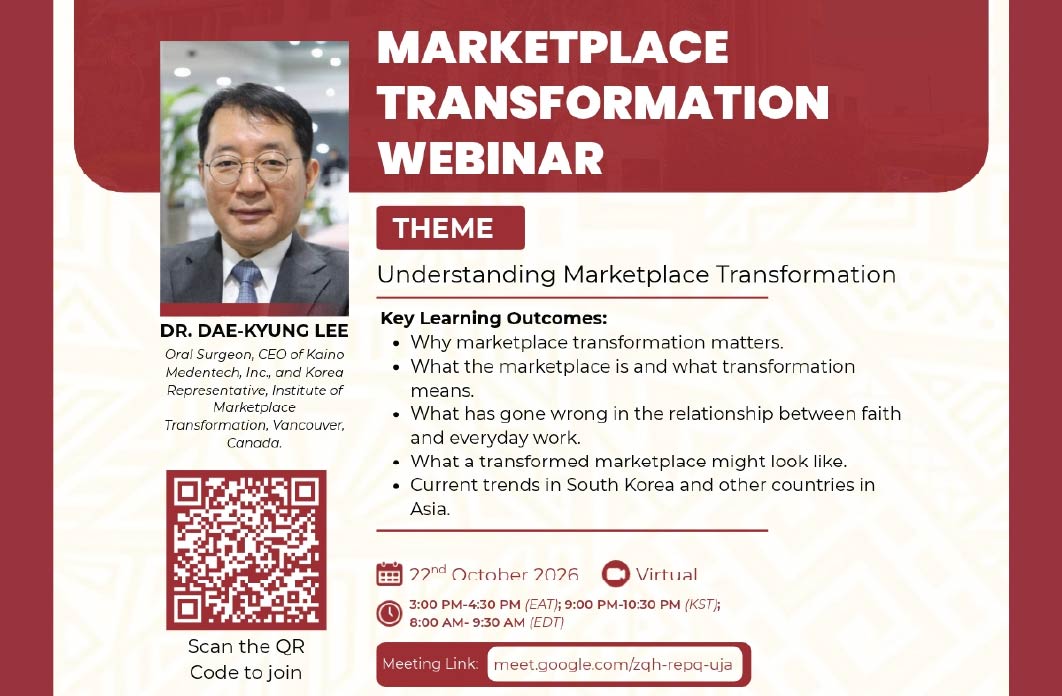
St. Paul’s University invites students, faculty, alumni, and the general public to an insightful virtual webinar titled "Marketplace Transformation". The session will feature Dr. Dae-Kyung Lee, an Oral Surgeon, CEO of Kaino Medentech, Inc., and Korea Representative for the Institute of Marketplace Transformation based in Vancouver, Canada.

Event Details

  • Theme: Understanding Marketplace Transformation
  • Date: Thursday,  October 2026
  • Time:

3:00 PM – 4:30 PM (EAT - East Africa Time)

9:00 PM – 10:30 PM (KST - Korea Standard Time)

8:00 AM – 9:30 AM (EDT - Eastern Daylight Time)

  • Format: Virtual (Google Meet)
  • Meeting Link: meet.google.com/zqh-repq-uja 

Key Discussion Areas & Learning Outcomes

During the webinar, participants will gain practical and strategic insights into:

  1. Why marketplace transformation matters in today's global landscape.
  2. Defining the marketplace and understanding what transformation truly entails.
  3. Examining the connection between faith and everyday work, including key areas of disconnect.
  4. Envisioning a transformed marketplace and practical leadership models.
  5. Emerging market trends across South Korea and other Asian nations.

How to Join

  • Direct Link: Click here to join via Google Meet at the scheduled time.
  • QR Code: You can also scan the QR code on the official poster using your smartphone camera to access the meeting.


SPU Advances Creative and Community Engaged Research Projects on Spirituality and Innovation in an Age of Economic Anxiety

SPU Advances Creative and Community Engaged Research Projects on Spirituality and Innovation in an Age of Economic Anxiety

JSOT Blog 19 October 2026
  • conference
  • workshop
  • seminar
  • research
  • spu
  • conferences
  • scholarships

Through the Directorate of Research and Innovation, St. Paul’s University (SPU) is advancing a distinctive research agenda that connects scholarship, innovation and community needs. Under the project “Spiritual Capital and Youth Innovation in an Age of Economic Anxiety” funded by the Templeton Religion Trust via Grant Number TRT-2025-35778, shortlisted proposals for postgraduate research scholarships bring theology into conversation with psychology, entrepreneurship, digital heritage and everyday economic challenges. Together, they demonstrate how St. Paul’s university is leading through research that asks locally grounded questions while opening new possibilities for public engagement and postgraduate learning.

The agenda for the Templeton Religion Trust proposal presentation meeting on 16 October 2026 brought together three internal sub-granted project proposals and nine postgraduate proposals. Its combination of presentations and panel feedback, at this early stages of the research projects placed research development alongside accountability. Rather than treating student research as an isolated academic exercise, this platform connects emerging scholarship with a shared thematic programme and opportunities for constructive exchange.

Supporting Early Career Research: Digital Archives, Developmental Science and Chaplaincy Innovation

Among the distinctive internal proposals, Irene Kibandi and Damaris Wambugu’s “Digitizing the Ecumenical Memory” envisages a pilot archive digitisation and decolonial church history project for SPU’s trustee churches. Mbutu Kariuki’s psycho-theological study explores cultivation, spiritual capital and flourishing among young innovators in Kenya. Duncan Mugambi’s proposal examines chaplaincy as innovative ministry, focusing on spiritual virtues and safeguarding youth mental health. These projects broaden the meaning of innovation beyond technology alone to include heritage, human development and care.

Strengthening Postgraduate Students’ Research: Sports and Faith-Based Entrepreneurship

Postgraduate proposals extend this interdisciplinary approach. PhD Theology student Kasereka Wamunyu Victoire explores football as youth missional innovation and a pathway for contextual thinking about church unity and ecumenical leadership in Kiambu County. MTh student Daniel Muhia Gathogo investigates faith-based entrepreneurship and marketplace discipleship in Kenya. Master’s in business studies student Paul Wahome Gichangi examines predatory lending and household finances in Nairobi, bringing the pressures behind economic anxiety into the research conversation. Their proposed studies connect innovative practices with questions of participation, livelihoods and community life.

Responding to the Mental Health Crises

Mental health is another strong thread. Jacqueline Kang’ori proposes integrating faith, African culture and psychological science in contextualised church ministry that bridges African/Gikuyu indigenous knowledge systems into conversation with scriptural foundations for mental health. M.A. Counselling Psychology student Nancy Wanjiku Kahindo examines spirituality and youth mental health resilience in Embu, while Pius Mogeni Wako explores pastoral responses to adolescent anxiety in Nairobi’s urban churches. PhD in Development Studies student Bahati Gatere explores parental leadership and its influence on strengthening the emotional resilience of the hearing-impaired youth. These studies aim to generate context-sensitive understanding that could inform community support. Their anticipated contribution should be understood as a research ambition, not yet as evidence of achieved outcomes.

Creating an Interdisciplinary Research Mentorship Ecosystem

SPU’s support for the next generation of researchers is also reflected in the early-career workshop scheduled for 19–23 October 2026 titled “Navigating the African Academy”. Alongside postgraduate proposal presentations and panel feedback, the workshop signals attention to researchers’ development as well as their projects. The programme creates space for emerging researchers to participate in an institutional conversation about rigorous, relevant scholarship and its relationship to communities. The researchers are being supported by more advanced researchers including the Rev. Dr. Kevin M. Ndereba, Dr. Mary Githinji, Dr. Daniel Nzengya, and Dr. Lisy Mutua, representing the different expertise in the various Schools.

Through this program, SPU presents a compelling model of research leadership: interdisciplinary inquiry rooted in real settings, opportunities for postgraduate and early-career participation, hands-on mentorship, and a focus on potential community benefit. As the proposals develop, the challenge and opportunity will be to translate their questions into credible evidence that helps communities navigate uncertainty and nurture innovation.

St. Paul’s University Strengthens Ethical AI and Open Science Capacity for Research and Innovation
Featured

St. Paul’s University Strengthens Ethical AI and Open Science Capacity for Research and Innovation

JSOT Blog 14 October 2026
  • conference
  • workshop
  • seminar
  • research
  • spu
  • training
  • conferences

A capacity-building workshop convened by the Directorate of Research and Innovation equipped 27 participants to use artificial intelligence responsibly, strengthen research integrity and advance open science across the University.

St. Paul’s University held a capacity-building workshop on 1 October 2026 at St. Julian’s Retreat Centre under the theme “Artificial Intelligence in Strengthening Ethical Research in the Age of Open Science” supported through the FOSTER Project “Fostering digital transformation of science in Kenya and Tanzania” (Reference number 101178078), a three-year initiative co-funded by the European Union through the Erasmus+ Programme under the Capacity Building for Higher Education (CBHE) Action. The training brought together 27 members of the University’s research community, including Institutional Scientific and Ethics Review Committee members, School Research Coordinators, academic staff, and undergraduate and postgraduate supervisors.

Through expert presentations, practical demonstrations and group discussion, participants examined the opportunities and ethical challenges associated with AI in research. The programme addressed bias and fairness, transparency, data privacy, authorship and academic integrity, alongside responsible uses of AI for literature discovery, data processing, manuscript development, editing and grant preparation. A dedicated session on the FOSTER Open Science Framework connected these capabilities with open-science policy, curriculum integration, institutional support and citizen engagement.

Impact achieved

The workshop expanded the University’s internal capacity for informed and ethical engagement with AI by creating a shared foundation across research ethics oversight, research coordination and academic supervision. The 27 participants were exposed to practical approaches for assessing AI-related risks, protecting research participants and data, maintaining human accountability, and recognising appropriate and inappropriate uses of generative tools. The training also strengthened awareness of open, transparent and collaborative research practices and concluded with action planning to translate learning into academic and research workflows.

Institutionally, the initiative advances the Directorate of Research and Innovation’s mandate and supports the University’s Christian identity through stewardship, integrity, human dignity and academic excellence. It provides a basis for strengthening guidance for ethical review, supervision, research data management, responsible AI use and open dissemination, while encouraging interdisciplinary collaboration and innovation that responds to societal needs.

Connecting institutional action to policy

At national level, the workshop contributes to the Kenya Artificial Intelligence Strategy 2025–2030, particularly its emphasis on AI research and innovation, talent development, data governance, and ethics, equity and inclusion. By building the capabilities of researchers, supervisors and ethics-review personnel, the University is helping to develop the skilled and accountable research ecosystem required for locally relevant AI solutions in education and other priority sectors.

Regionally, the initiative aligns with the African Union Continental Artificial Intelligence Strategy and Agenda 2063 through an Africa-centred, development-oriented approach that seeks to harness AI’s benefits, build capabilities, minimise risks, stimulate investment and foster cooperation. It positions higher education institutions to generate context-responsive knowledge, strengthen African data and research capacity, and translate innovation into inclusive social and economic value.

Internationally, the workshop reflects UNESCO’s Recommendation on the Ethics of Artificial Intelligence, with its focus on human rights, dignity, transparency, fairness and human oversight, and the UNESCO Recommendation on Open Science, which promotes accessible, inclusive, transparent and collaborative research. Together, these frameworks reinforce the need to pair technological capability with ethical governance, equitable participation, research quality and public benefit.

Opportunities for higher education research and innovation

The convergence of responsible AI and open science creates significant opportunities for St. Paul’s University and the wider higher education sector. These include accelerating evidence synthesis and data analysis; developing locally relevant and multilingual AI solutions; improving research administration and grant development; strengthening reproducibility through responsible data and methods sharing; expanding interdisciplinary and cross-border collaboration; and widening public access to research and innovation. Realising these opportunities will require clear institutional guidance, appropriate infrastructure, continuous capacity building, ethical and data-protection safeguards, and recognition systems that reward open and responsible research practices.

The Directorate of Research and Innovation will build on the workshop by supporting policy development, curriculum integration, communities of practice and partnerships that move the University from awareness to responsible experimentation and measurable research impact. The engagement marks an important step towards a research culture in which AI augments—rather than replaces—human judgement, and open science strengthens the reach, credibility and societal value of scholarship.


Opening Up African Scholarship: St. Paul’s University Advances Open Science

Opening Up African Scholarship: St. Paul’s University Advances Open Science

JSOT Blog 15 October 2026
  • conference
  • workshop
  • seminar
  • research
  • conferences

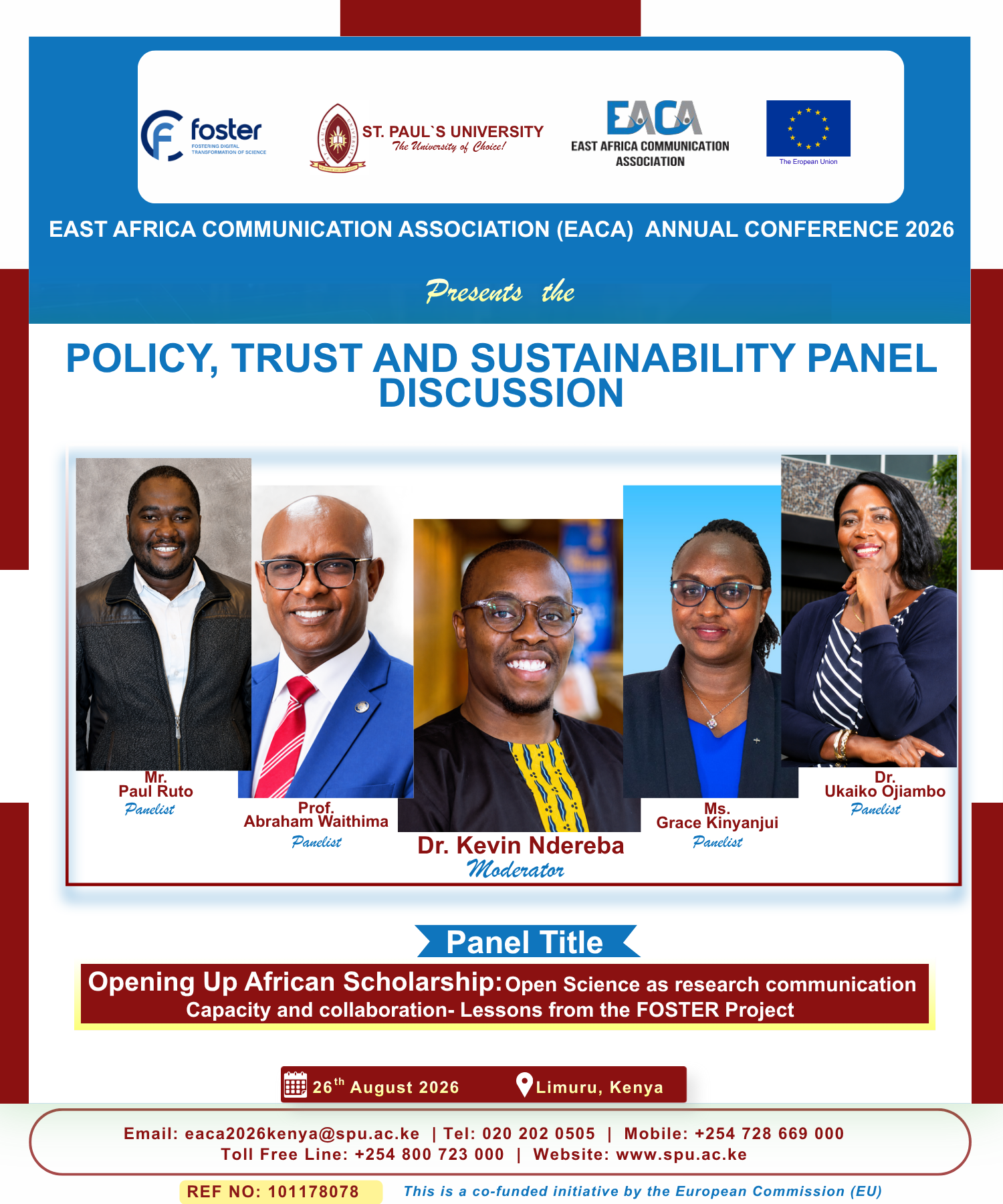
How can African universities ensure that research is not only produced, but also accessible, trusted and co-created with communities? This question anchors St. Paul’s University’s Open Science panel programme for the 16th East African Communication Association (EACA) Annual Conference, dated 26–28 August 2026 in Limuru, Kenya. Entitled “Opening Up African Scholarship: Open Science as Research Communication, Capacity, and Collaboration — Lessons from the FOSTER Project”, the panel connects the future of African scholarship with practical institutional change.

The programme draws on FOSTER (REF NO. 101178078) — “Fostering Digital Transformation of Science in Kenya and Tanzania” — a three-year Capacity Building Higher Education (CBHE) initiative co-funded by the European Union’s Erasmus+ Programme. Bringing together nine partners across Kenya, Tanzania, Slovenia, the Netherlands and Spain, including St. Paul’s University, FOSTER advances researcher training, citizen science, data infrastructure, inclusive policy and Africa–Europe collaboration.

Critical Questions for African Research

Convened by Rev. Dr. Kevin Muriithi Ndereba, Director of Research and Innovation, the panel programme brought together Dr. Ukaiko Ojiambo, Paul Ruto, Irene Kibandi and Grace Kinyanjui. Its five interconnected themes span research ecosystems, university strategy, science communication, citizen science and virtual learning.

At its centre is a critical distinction: making research available does not automatically make participation equitable. The discussion framework asks how African scholarship can become more visible and influential without being extracted from, particularly in an AI-mediated research environment. It also interrogates how universities can balance global openness frameworks with local priorities, resources and quality assurance.

Public trust and meaningful participation are equally central. The programme asks how research can be communicated beyond academic audiences, how communities can become knowledge co-producers rather than research subjects, and how digital learning can expand access without leaving people behind because of connectivity, skills or platform barriers. These questions position Open Science as a communication and institutional challenge, not simply a technological upgrade.

Turning Commitment into Practice

St. Paul’s University is translating this agenda into action by integrating Open Science into its 2025–2030 Strategic Plan. Four complementary areas demonstrate how the University is leading through a connected approach to policy, publishing, community collaboration and learning.

A policy foundation. The University’s Open Science policy provides the institutional framework for its openness agenda. Embedding this commitment within university strategy connects Open Science with long-term institutional direction rather than treating it as a stand-alone project.

A platform for African scholarship. The University’s indexed, peer-reviewed, open-access Africa Multidisciplinary Journal provides a space for African scholars to contribute to knowledge. It gives practical expression to the panel’s concern with accessible scholarly publishing and African participation in knowledge production.

A hub for community co-creation. The Open Science Hub to be launched early 2027 connects the University with community actors to co-design projects around mental health, poverty reduction, training for small and medium-sized enterprises (SMEs), climate-smart agriculture and the use of artificial intelligence. Housed on the second floor of the Postgraduate Building, the contemporary space features state-of-the-art infrastructure, including smart boards, smart screens, foldable seats and chairs. Its design fosters creative collaboration, providing a physical setting for the participatory research approach at the heart of Open Science.

Learning that extends beyond campus. A master’s-level course, “Open Science and Ethical Research”, embeds the agenda in postgraduate education. Informal courses available to the public through the University’s learning management system further extend opportunities to engage with Open Science beyond formal degree programmes.


Together, these initiatives show how St. Paul’s University is moving from commitment to an interconnected Open Science ecosystem. By linking institutional frameworks with African publishing, community partnerships and education, the University is helping shape a more open, inclusive and collaborative future for research.

Jamhuri Kenya Campus and TVET Awards 2026

St. Paul’s University Trailblazers Triumph at Jamhuri Kenya Campus & TVET Awards 2026

SPU Admin Blog 12 October 2026


St. Paul’s University (SPU) continues to solidify its reputation as a crucible for transformative leadership and entrepreneurial innovation. In a historic show of excellence, two SPU students emerged as top awardees at the prestigious Jamhuri Kenya Campus and TVET Awards 2026, held on Saturday, 26th September 2026.

The annual awards ceremony celebrates outstanding post-secondary students across Kenya who exhibit exceptional vision, leadership, and drive toward societal impact.

Double Victory for SPU Innovators and Leaders

The awards night highlighted the institution's commitment to nurturing holistic, impact-driven change-makers across diverse disciplines.

  • Outstanding Student Entrepreneurship & Business Innovation Award – East Africa

Winner: Paulette Hawi (School of Business and Leadership Studies)

Paulette, an active innovator at SPU iPARK, earned regional recognition for her pioneering work in student entrepreneurship. Her award underscores SPU’s vibrant incubation environment, where young minds transform venture ideas into scalable, real-world solutions.

  • Female Student Leadership & Impact Excellence Award – 2026

Winner: Sabina Nzuna (School of Communication and Computer Science)

Serving as the Vice Chairperson of the St. Paul’s University Students Association (SPUSA), Sabina was honored for her dedicated service, student advocacy, and exemplary leadership across campus communities.

Shaping the Agenda: "Beyond the Classroom"

Beyond taking home top accolades, SPU’s presence was strongly felt during the event’s flagship intellectual session. Paulette Hawi was invited to represent student innovators on an executive panel discussing the theme: ‘Beyond the Classroom: Leadership for Africa’s Future.’

Panellists engaged in a thought-provoking exchange alongside notable young leaders from higher education and industry, including:

  • Bennyhinn Walubengo — Founder & Chief Visionary Officer, iSpeak Academy
  • John Muchai — Dedan Kimathi University of Technology (DeKUT)
  • Mutua Titus — Tharaka University
  • Enock Kwena — Moi University

The discussion explored how higher learning institutions can equip students to look beyond theoretical coursework and leverage leadership positions to solve pressing community challenges across Africa.

Empowering Tomorrow’s Changemakers

Reflecting on their victories, both Paulette and Sabina emphasized that these awards serve as a catalyst to expand their work—inspiring fellow students to embrace bold initiative, ethical leadership, and service to society.

"Leadership is not just about holding positions—it's about making a difference, inspiring others, and serving with integrity."

St. Paul’s University extends its heartfelt congratulations to Paulette Hawi and Sabina Nzuna for flying the SPU banner high and demonstrating the transformative power of holistic Christian higher education.


  1. St. Paul’s University and NIBS Partner to Strengthen Technical Education and Academic Pathways
  2. SPU Concludes Landmark "Innovate for Impact 2026" Conference, Unveiling Scalable Solutions for East Africa’s Green Economy
  3. St. Paul’s University Teams Up with Kirogo Boys Senior School for Faith, Mentorship, and Career Day
  4. Prof. Esther Mombo Installed as 4th Vice Chancellor of St. Paul's University

About US

  • Our History
  • Vision & Mission
  • Careers
  • Tenders
  • Partnership
  • Our Blog

Academics

  • Research
  • Programmes
  • Schools
  • Admissions
  • E-Learning Portal
  • University Library
  • Academic Registry

Quick Links

  • Nairobi Campus
  • Nakuru Campus
  • Virtual Campus
  • Scholarships
  • Conference
  • FAQs
  • Media Centre

Connect With Us

P.O. Box Private Bag,
Limuru, 00217, Kenya.

Phone: +254 800 723 000

Email: info@spu.ac.ke

Email: contactcenter@spu.ac.ke

Copyright © 2026 St. Paul's University
Data Protection Notice