

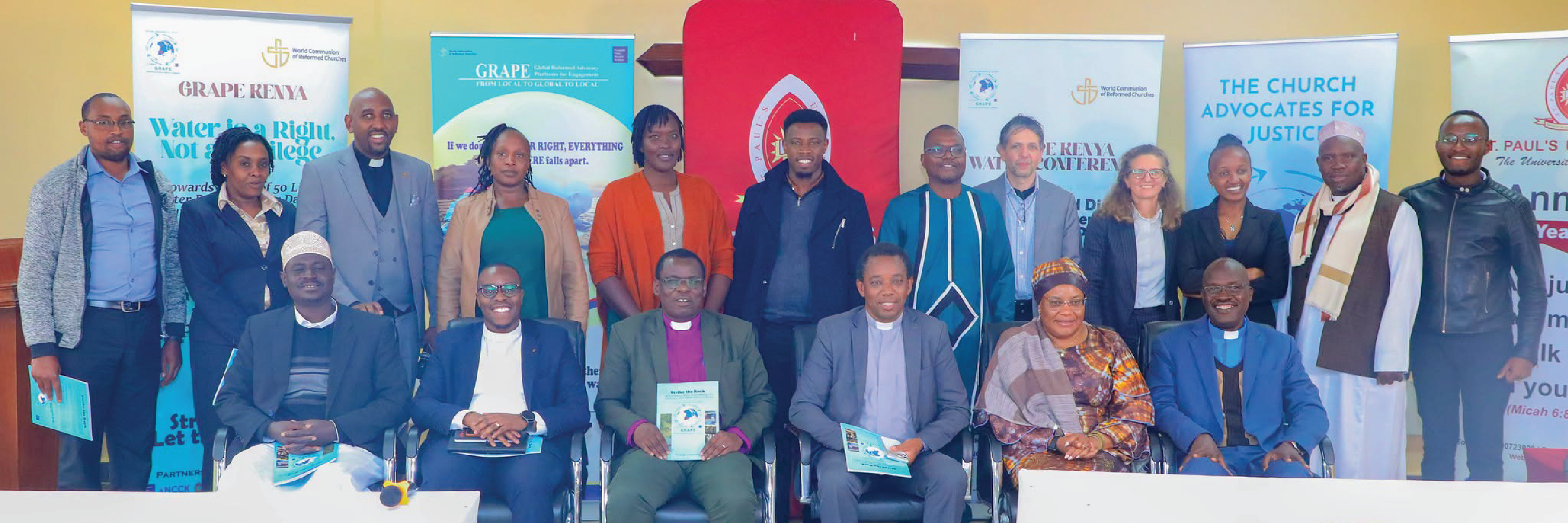
LIMURU, KENYA — What happens when academia, the church, and civil society speak with one unified voice? A powerful call to social justice emerges—one capable of shifting national policy and holding duty-bearers accountable.
On Tuesday, 18th August 2026, the historic Limuru campus of St. Paul’s University served as the platform for this pivotal moment during the National GRAPE Water Conference. Bringing together theologians, scholars, legal experts, policy advocates, and church leaders, the conference examined a fundamental constitutional imperative: the right of every Kenyan to safe, clean water.
A Bold Demand for Basic Dignity
Participants at the conference issued a unified resolution calling on the Kenyan government to operationalize the constitutional right to water by delivering 50 litres of safe, clean drinking water per person per day, or providing equivalent cash compensation to households lacking access.
The resolution reflects growing concern that despite clear constitutional protections, millions of citizens continue to face acute water insecurity—impacting health, education, economic stability, and human dignity.
Theological, Legal, and Economic Foundations
The conference provided a comprehensive exploration of water access across three distinct pillars:
-
Theological Foundations: Faith leaders underscored water as a divine gift essential for life and human flourishing. Access to clean water is rooted in sacred principles of stewardship, social justice, and compassion.
-
Legal Foundations: Legal scholars highlighted Article 43 of the Constitution of Kenya, which guarantees the right to clean and safe water in adequate quantities. They emphasized that failure to fulfill this right directly violates human dignity.
-
Economic Foundations: Policy experts demonstrated that investing in universal water access yields substantial social and economic dividends—reducing healthcare burdens, increasing workplace productivity, and lifting vulnerable communities out of poverty.
Distinguished Leadership and Collaboration
The conference was co-organized by three leading institutions committed to social transformation and evidence-based policy advocacy:
-
St. Paul’s University’s Directorate of Research and Innovation
-
The Economic Policy Research Institute (EPRI)
-
The World Communion of Reformed Churches (WCRC)
The GRAPE Conference was officially opened by Prof. Esther Mombo, Vice-Chancellor of St. Paul's University. In her opening remarks, Prof. Mombo emphasized the moral responsibility of academic institutions to partner with faith communities and civil society in addressing systemic social challenges.
Among the prominent leaders and key stakeholders present were:
-
Rev. Dr. Robert Waihenya, Secretary General of the Presbyterian Church of East Africa (PCEA)
-
Rev. Dr. Luka Ariko, General Secretary of the Reformed Church of East Africa (RCEA)
-
Representatives from academic faculties, civil society coalitions, and community advocacy groups.
Moving Forward: A Call to Action
The National GRAPE Water Conference closed with a strong pledge to convert dialogue into action. By aligning intellectual rigor, moral authority, and grassroots advocacy, this dynamic coalition aims to engage state agencies, parliamentarians, and county governments to ensure that the 50-litre benchmark becomes a practical reality for every household in Kenya.
"Water is not merely a commodity; it is a fundamental human right that safeguards the dignity of human life across all spheres of society."
For media inquiries, full policy briefs, or conference proceedings, please contact the Directorate of Research and Innovation at St. Paul’s University.