

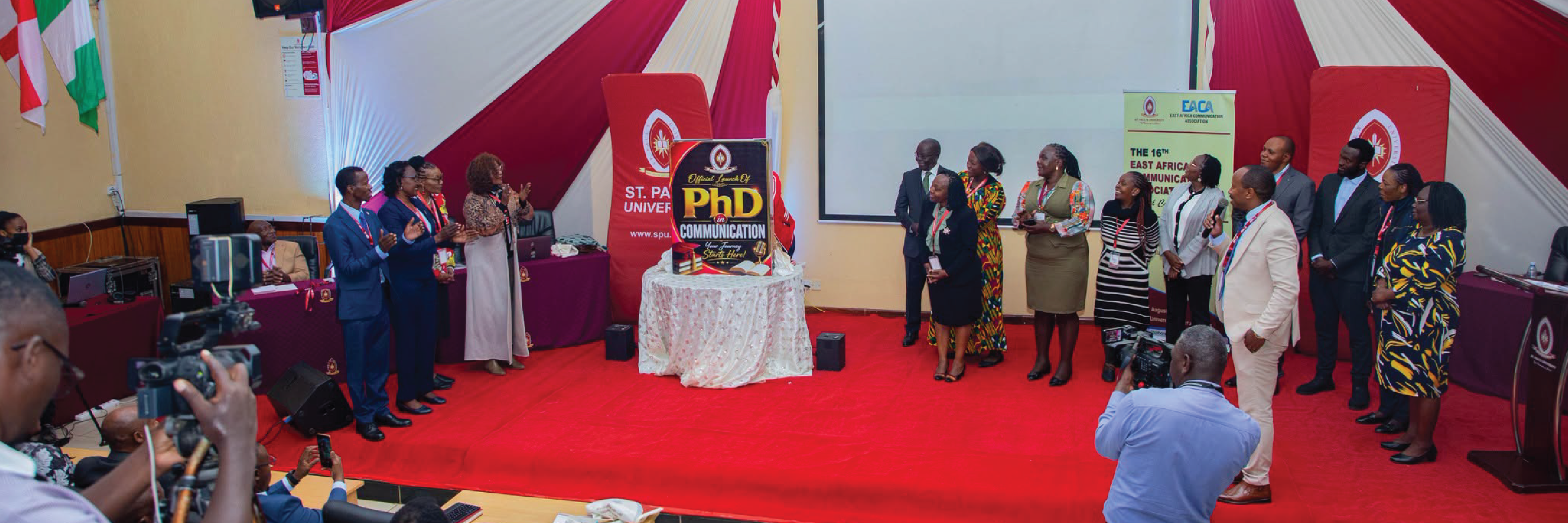
How can African universities ensure that research is not only produced, but also accessible, trusted and co-created with communities? This question anchors St. Paul’s University’s Open Science panel programme for the 16th East African Communication Association (EACA) Annual Conference, dated 26–28 August 2026 in Limuru, Kenya. Entitled “Opening Up African Scholarship: Open Science as Research Communication, Capacity, and Collaboration — Lessons from the FOSTER Project”, the panel connects the future of African scholarship with practical institutional change.
The programme draws on FOSTER (REF NO. 101178078) — “Fostering Digital Transformation of Science in Kenya and Tanzania” — a three-year Capacity Building Higher Education (CBHE) initiative co-funded by the European Union’s Erasmus+ Programme. Bringing together nine partners across Kenya, Tanzania, Slovenia, the Netherlands and Spain, including St. Paul’s University, FOSTER advances researcher training, citizen science, data infrastructure, inclusive policy and Africa–Europe collaboration.
Critical Questions for African Research
Convened by Rev. Dr. Kevin Muriithi Ndereba, Director of Research and Innovation, the panel programme brought together Dr. Ukaiko Ojiambo, Paul Ruto, Irene Kibandi and Grace Kinyanjui. Its five interconnected themes span research ecosystems, university strategy, science communication, citizen science and virtual learning.
At its centre is a critical distinction: making research available does not automatically make participation equitable. The discussion framework asks how African scholarship can become more visible and influential without being extracted from, particularly in an AI-mediated research environment. It also interrogates how universities can balance global openness frameworks with local priorities, resources and quality assurance.
Public trust and meaningful participation are equally central. The programme asks how research can be communicated beyond academic audiences, how communities can become knowledge co-producers rather than research subjects, and how digital learning can expand access without leaving people behind because of connectivity, skills or platform barriers. These questions position Open Science as a communication and institutional challenge, not simply a technological upgrade.
Turning Commitment into Practice
St. Paul’s University is translating this agenda into action by integrating Open Science into its 2025–2030 Strategic Plan. Four complementary areas demonstrate how the University is leading through a connected approach to policy, publishing, community collaboration and learning.
A policy foundation. The University’s Open Science policy provides the institutional framework for its openness agenda. Embedding this commitment within university strategy connects Open Science with long-term institutional direction rather than treating it as a stand-alone project.
A platform for African scholarship. The University’s indexed, peer-reviewed, open-access Africa Multidisciplinary Journal provides a space for African scholars to contribute to knowledge. It gives practical expression to the panel’s concern with accessible scholarly publishing and African participation in knowledge production.
A hub for community co-creation. The Open Science Hub to be launched early 2027 connects the University with community actors to co-design projects around mental health, poverty reduction, training for small and medium-sized enterprises (SMEs), climate-smart agriculture and the use of artificial intelligence. Housed on the second floor of the Postgraduate Building, the contemporary space features state-of-the-art infrastructure, including smart boards, smart screens, foldable seats and chairs. Its design fosters creative collaboration, providing a physical setting for the participatory research approach at the heart of Open Science.
Learning that extends beyond campus. A master’s-level course, “Open Science and Ethical Research”, embeds the agenda in postgraduate education. Informal courses available to the public through the University’s learning management system further extend opportunities to engage with Open Science beyond formal degree programmes.
Together, these initiatives show how St. Paul’s University is moving from commitment to an interconnected Open Science ecosystem. By linking institutional frameworks with African publishing, community partnerships and education, the University is helping shape a more open, inclusive and collaborative future for research.