St. Paul St. Paul's University

ST. PAUL'S UNIVERSITY The University of Choice!

  • Staff Portal
  • Students Portal
  • E-learning Portal
  • TVET Institute
  • Library
  • Research
  • Graduation
  • Blog
  • Check Mail
  • Home
  • About Us
    • History
    • Vision, Mission and Philosophy
    • Core Values and Objectives
    • Governance
      • Chancellor
      • Board of Trustees
      • University Council
      • University Management Board
      • University Senate
    • Facilities and Amenities
      • SPU Enterprise Unit
      • SPU Health Services
    • Directorates
      • Board of Postgraduate Studies
      • Virtual Campus
      • Quality Assurance
    • Campuses
      • Nairobi Campus
      • Nakuru Campus
      • Virtual Campus
    • Partnerships
    • Careers
    • Scholarship
  • Academics
    • Academic Programmes
    • Schools
      • Theology
      • Education & Social Sciences
      • Business & Leadership Studies
      • Health Sciences
      • Communication & Computer Studies
  • Admissions
    • Admission Regulations
    • Government Sponsored students
    • Refer a Friend and Earn an SPU Reward
  • Downloads
  • Students Life
  • SPU News
  • Contact Us
  • Home
  • About Us
    • History
    • Vision, Mission and Philosophy
    • Core Values and Objectives
    • Governance
      • Chancellor
      • Board of Trustees
      • University Council
      • University Management Board
      • University Senate
    • Facilities and Amenities
      • SPU Enterprise Unit
      • SPU Health Services
    • Directorates
      • Board of Postgraduate Studies
      • Virtual Campus
      • Quality Assurance
    • Campuses
      • Nairobi Campus
      • Nakuru Campus
      • Virtual Campus
    • Partnerships
    • Careers
    • Scholarship
  • Academics
    • Academic Programmes
    • Schools
      • Theology
      • Education & Social Sciences
      • Business & Leadership Studies
      • Health Sciences
      • Communication & Computer Studies
  • Admissions
    • Admission Regulations
    • Government Sponsored students
    • Refer a Friend and Earn an SPU Reward
  • Downloads
  • Students Life
  • SPU News
  • Contact Us
  • Staff and Students Resources
  • Staff portal
  • Students Portal
  • E-learning Portal
  • SPUAIRC 2025
  • Careers
  • Library
  • Research
  • Blog
  • Journals
  • Check Mail

Apply Now!

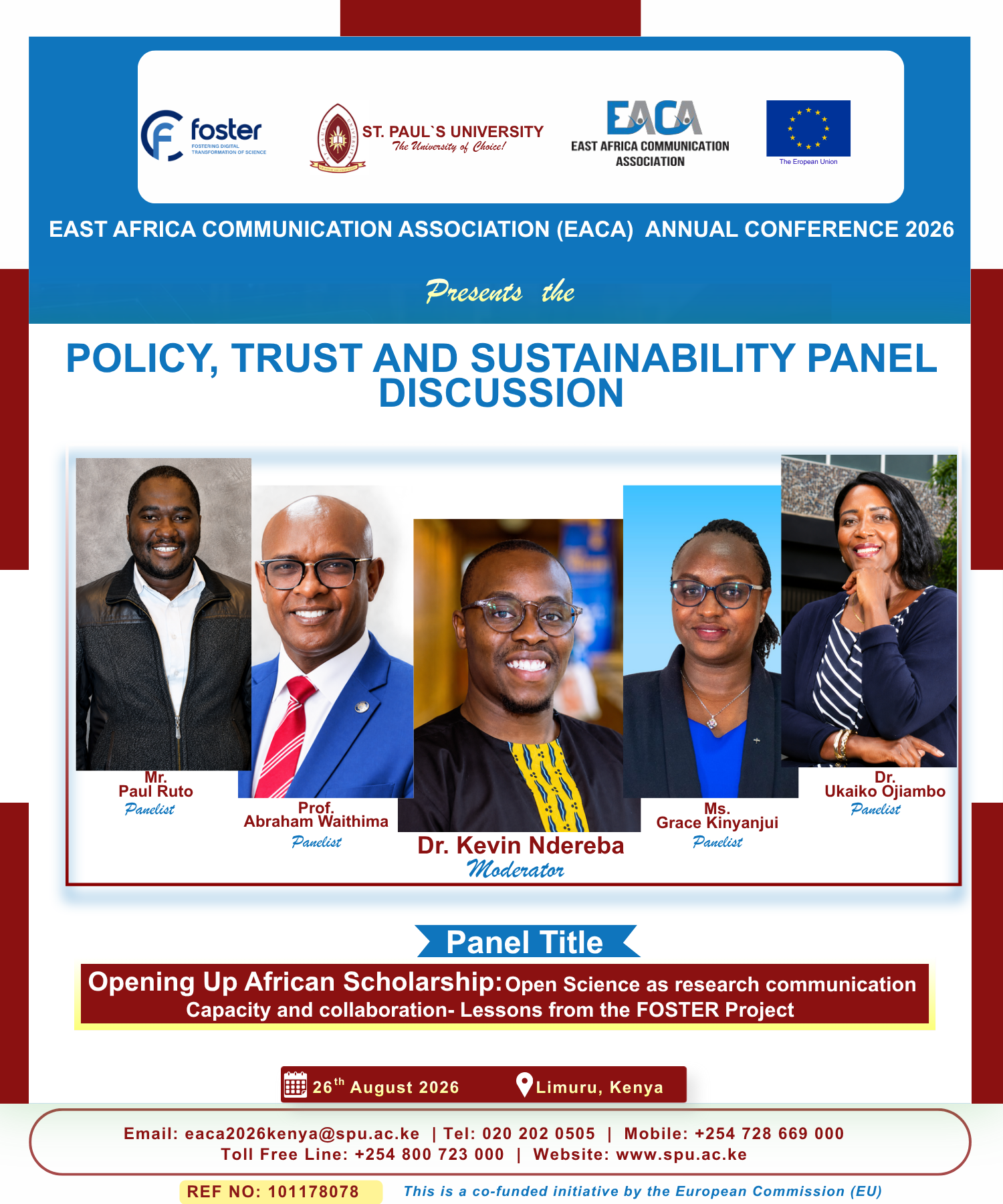
AI, Innovation, and Identity: St. Paul’s University to Host 16th EACA Conference

AI, Innovation, and Identity: St. Paul’s University to Host 16th EACA Conference

SPU Admin Blog 17 March 2026

The digital landscape in Africa is shifting at breakneck speed. From the rise of generative AI to the evolving role of community journalism, the way we tell stories and share information is being redefined.

To tackle these transformations head-on, St. Paul’s University-Kenya (School of Communication and Computer Studies) and the East African Communication Association (EACA) are proud to announce the 16th EACA Conference.

Event Details

  • Theme: "Reimagining Communication in Africa: AI, Media Innovation and Global Collaboration"

  • Dates: 26th – 28th August 2026

  • Location: Limuru, Kenya

Why This Conference Matters

This isn't just another academic gathering. It is a melting pot of scholars, practitioners, creatives, and policymakers. The goal is to bridge the gap between local roots and global connections, ensuring African voices remain at the forefront of the technological revolution.

Key areas of focus include:

  • Digital Transformation: Navigating the AI frontier in media.

  • Integrity in Information: Combatting misinformation and strengthening policy.

  • Cultural Identity: Exploring creative industries and local expression.

  • Community Impact: Enhancing mainstream and grassroots media practices.

What to Expect

The three-day event is designed to be highly interactive, moving beyond traditional lectures to create "actionable insights." Participants can look forward to:

  1. Paper Sessions & Panels: Deep dives into the latest communication research.

  2. Practitioner Forums: Real-world perspectives from industry leaders and journalists.

  3. Community-Engaged Sessions: Collaborative workshops aimed at solving regional communication challenges.

Join the Conversation

Whether you are an early-career researcher looking for mentorship or an industry veteran looking to influence policy, EACA 2026 offers a platform to co-develop practical responses to the challenges of our time.

Click Here for More Details

Beyond the Shadows: Ambassador Gentiana Serbu on the Threat of "Mafiocracy" to Global Democracy

Beyond the Shadows: Ambassador Gentiana Serbu on the Threat of "Mafiocracy" to Global Democracy

SPU Admin Blog 16 March 2026

Last Friday, during a compelling Public Lecture on "Organized Crime and Democracy," H.E. Mrs. Gentiana Serbu, Ambassador of the Republic of Romania to Kenya, delivered a stern warning about the insidious infiltration of state structures by Organized Crime Groups (OCGs).

Her presentation shed light on the alarming ways these groups exploit state weaknesses to advance their illicit agendas, ultimately undermining the foundations of democracy and the rule of law.

The Mechanics of Infiltration

Ambassador Serbu emphasized that OCGs are not just simple criminal syndicates; they are sophisticated organizations that have learned to manipulate state machinery to their advantage. They establish themselves within political spheres, sometimes even masking their true intentions through intricate public relations strategies.

Once embedded within these structures, OCGs utilize a range of tactics to:

  • Exploit Violence: Employing threats, intimidation, and physical harm to silence opponents, influence decision-making, and maintain control.

  • Manipulate Elections: Interfering with the electoral process through voter intimidation, ballot stuffing, and illicit campaign funding to ensure the selection of candidates who will serve their interests.

  • Corrupt Legislation: Bribing public officials to enact laws that favor their illegal activities or obstruct efforts to combat organized crime.

A Systemic Threat to Democracy

This infiltration goes far beyond simple corruption. OCGs compromise key state institutions, including police forces, bureaucracies, and electoral bodies, creating a system where the very entities responsible for upholding the law are instead serving the interests of criminals.

Ambassador Serbu labeled this phenomenon as "mafiocracy," a state where organized crime has effectively usurped governmental roles. This erosion of the rule of law creates a breeding ground for impunity, allowing OCGs to operate with relative freedom and inflict devastating consequences on society.

The Global Scope of Mafiocracy

While often associated with post-Soviet states, Ambassador Serbu stressed that mafiocracy is a global threat. Its tentacles extend across borders, posing a significant challenge to democracy, human rights, and economic development worldwide.

A Call for Concerted Action

The infiltration of state structures by OCGs demands a concerted effort from all sectors of society. Ambassador Serbu highlighted the crucial role of:

  • Government Institutions: Strengthening state capacity, enhancing transparency, and implementing robust anti-corruption measures are essential to resist organized crime infiltration.

  • Civil Society: Holding public officials accountable, demanding greater transparency, and advocating for reforms that combat organized crime.

  • Media: Exposing organized crime activities, investigating corruption, and raising public awareness about the dangers of mafiocracy.

  • Institutions of Higher Learning: Conducting research, developing innovative strategies to combat organized crime, and educating future leaders about the importance of ethical conduct and the rule of law.

Conclusion

Ambassador Serbu's presentation served as a timely reminder of the grave threat that organized crime poses to democracy. By understanding the mechanics of infiltration and recognizing the global scope of the problem, we can take concerted action to protect our democratic institutions and ensure the rule of law prevails.

New Funding Opportunities: Bridging Science and Theology in Africa

New Funding Opportunities: Bridging Science and Theology in Africa

SPU Admin Blog 11 March 2026

Are you a postgraduate student conducting research at the intersection of faith and science? Or perhaps a church leader and scientist looking to inspire your congregation? Equipping Christian Leadership in an Age of Science (ECLAS) – Africa Hub is thrilled to announce two major grant opportunities for 2026-2027.

Based at St. Paul’s University, ECLAS Africa is dedicated to developing a contextual theology of science that strengthens African communities by "engaging globally and acting locally". We are currently seeking expressions of interest for the following programs:

1. Research Grants for Postgraduate Students

We are offering financial support for fieldwork expenditures to students dedicated to bridging the gap between Science and Theology.

  • Eligibility: Postgraduate students at the thesis/dissertation writing stage, targeting graduation in 2026 or 2027.
  • Award Amount: Up to KES 185,000 per successful applicant.
  • Availability: Grants are available for four students.
  • How to Apply: Submit a brief research concept including your project title, school details, denomination, supervisors, and a concept paper (problem statement, objectives, design, etc.).
 Learn MoRE


2. Scientists in Congregations (2026-2027)

This initiative invites church leaders who are also scientists (e.g., nurses, engineers, dietitians) to create creative projects that foster scientific engagement within their local communities.

  • Focus: We are looking for projects that build confidence around scientific issues and produce resources for wider congregational use.
  • Award Amount: Funding of up to KES 350,000 per project.
  • Project Duration: Maximum of 6 months.
  • Availability: Funding is available for 6 projects, with a special encouragement for applications from African Instituted Churches.
  • How to Apply: Submit a Letter of Intent (max 2 pages) detailing your project title, the specific Christian community involved, an introduction (500 words), and a breakdown of your intended outcomes, budget, and timeline.

Important Deadlines & Contact Information

The deadline for both expressions of interest is 25th March 2026.

  • Submit to: Director, ECLAS Africa Hub
  • Email: This email address is being protected from spambots. You need JavaScript enabled to view it.
  • Learn More: Visit our website at eclasafrica.org
 Learn MoRE

Join us in fostering thoughtful, prayerful communities working at the leading edge of science and faith.


Celebrating Collaboration: St. Paul’s University and ICS Sign Landmark MOU

Celebrating Collaboration: St. Paul’s University and ICS Sign Landmark MOU

SPU Admin Blog 12 March 2026

Earlier this week, on March 9th, 2026, St. Paul’s University (SPU) marked a significant milestone in its mission to enhance professional excellence and academic growth. In a formal ceremony held on Monday, the University officially entered into a Memorandum of Understanding (MOU) with the Institute of Certified Secretaries (ICS).

The event, expertly guided by Master of Ceremonies Mr. Michael Mungai, brought together key leadership from both institutions to pave the way for future collaborative success.

Highlights of the Ceremony

The afternoon began with a sense of purpose and reflection, setting a collaborative tone for the discussions that followed.

  • A Spiritual Foundation: The ceremony commenced at 1:30 p.m. with an opening prayer led by Dr. Wanjiku Kinyanjui.
  • Setting the Stage: Prof. Abraham Waithima (DVCAA) provided the opening remarks and introductions, followed by brief remarks from Dr. Mwirigi Kiula (DVCFA).
  • Visionary Leadership: Prof. Esther Mombo, Vice Chancellor of St. Paul's University, shared her insights on the importance of this partnership for the university community.
  • Industry Perspective: Representing the Institute of Certified Secretaries, CS Gloria Kikete (Corporate Secretary) and FCS Jeremiah Karanja (CEO) spoke on the value of bridging the gap between professional practice and academia.

The Official Signing

The climax of the event took place at 2:20 p.m., as the Registrar of Academic Affairs joined representatives from ICS to officially sign the MOU. This document signifies a commitment to shared goals, professional development, and the empowerment of students and practitioners alike.

The session concluded with a vote of thanks and a closing prayer by Dr. Paul Gesimba, followed by a series of photo sessions to document the historic occasion.

"Servants of God and Humanity" — The SPU motto was truly reflected in this partnership aimed at bettering the professional landscape.

This partnership with ICS represents SPU’s ongoing dedication to providing students with pathways to professional certification and industry-standard expertise. We look forward to the many opportunities this collaboration will bring to our community!


St. Paul’s University Hosts Global Post-Nicaea Conference on Theology and Social Transformation

St. Paul’s University Hosts Global Post-Nicaea Conference on Theology and Social Transformation

SPU Admin Blog 04 March 2026

St. Paul’s University recently hosted the Post-Nicaea Conference, an international theological gathering that brought together scholars, clergy, students, and ecumenical partners from across the world to reflect on the enduring legacy of the Council of Nicaea and its relevance for contemporary social transformation.
Held under the theme “Theological Bridges: Nicaea in Conversation with Decolonial Theology and Contemporary Movements for Social Change,” the conference built on the momentum of the 1700th anniversary of the Council of Nicaea, commemorated globally in 2025 during the World Council of Churches Sixth World Conference on Faith and Order in Egypt.
More than 100 participants from diverse ecclesial, academic, and cultural backgrounds gathered at St. Paul’s University in Limuru for a week of vibrant dialogue, theological reflection, and ecumenical engagement. The conference emphasized intergenerational conversations, bringing together established scholars, church leaders, and emerging theologians.
Key ecumenical partners included the World Council of Churches (WCC), Council for World Mission (CWM), World Communion of Reformed Churches (WCRC), All-Africa Conference of Churches (AACC), National Council of Churches of Kenya (NCCK), and the Orthodox Seminary in Kenya.
With its 125-year legacy of ecumenical witness and theological education for social transformation, St. Paul’s University continues to provide a platform for critical theological conversations that address the pressing realities of our time.

Key Reflections from the Conference

Participants engaged in robust discussions that highlighted several important insights:

  • Church and Empire: The Council of Nicaea emerged within complex relationships between church and imperial power, reminding contemporary Christians to remain attentive to the influence of political power in shaping theological discourse.
  • The Creed’s Counter-Imperial Witness: Despite imperial oversight, the Nicene Creed affirms a powerful theological claim: Christ—not Caesar—is Lord, offering a vision that challenges unjust power structures.
  • Human Dignity and Inclusion: The Nicene faith calls the Church to uphold the dignity of every human being, emphasizing that Christian unity must be inseparable from justice, inclusion, and respect for diverse identities.
  • Justice and Peace: Participants affirmed that Christian unity must be expressed through just governance, peacebuilding, and resistance to systemic inequality.
  • Holistic Flourishing: Theological reflection must engage contemporary issues such as ecological responsibility, public health, and community well-being, connecting doctrine with everyday lived realities in Africa and beyond.

A Call to Action
The conference concluded with a strong call for the global church to move toward transformative and decolonial theological engagement, including:

  • Practical Decoloniality: Moving beyond rhetoric to concrete actions that dismantle colonial patterns in theology and church structures.
  • Youth Inclusion: Ensuring that young people are fully involved in leadership, dialogue, and decision-making processes within church and theological spaces.
  • Theology for Social Transformation: Reimagining theology as a tool for addressing urgent global challenges such as climate justice, gender justice, racial justice, and economic inequality.
  • A Prophetic Church: Re-envisioning the church as a courageous space that centres marginalized voices and speaks prophetically in pursuit of justice and peace.
  • Listening as a Spiritual Practice: Cultivating deep listening across generations and cultures as a pathway to healing divisions and fostering collaboration.


Looking Ahead
The Post-Nicaea Conference reaffirmed that the legacy of Nicaea is not simply a historical event but a living theological resource. In conversation with decolonial theology and contemporary movements for justice, the Nicene vision continues to inspire the church toward unity, justice, and transformative witness in today’s world.
Through gatherings such as this, St. Paul’s University remains committed to fostering theological dialogue that bridges tradition and contemporary realities, shaping a church that speaks meaningfully to the challenges of our time.


  1. A Legacy of Faith, Service, and Transformation: St. Paul’s University Bids Farewell to Rev. Canon Prof. James Kombo, Ph.D.
  2. Honoring a Legacy of Excellence: Farewell Ceremony for Rev. Canon Prof. James Kombo
  3. A New Chapter Begins: SPUAA Welcomes the 2026-2028 Leadership Team
  4. Reimagining Communication in Africa: Call for Abstracts for EACA 2026

About US

  • Our History
  • Vision & Mission
  • Careers
  • Tenders
  • Partnership
  • Our Blog

Academics

  • Programmes
  • Schools
  • Admissions
  • E-Learning Portal
  • University Library
  • Academic Registry
  • Media Centre

Quick Links

  • Nairobi Campus
  • Nakuru Campus
  • Virtual Campus
  • Scholarships
  • Conference
  • FAQs

Connect With Us

P.O. Box Private Bag,
Limuru, 00217, Kenya.

Phone: +254 20 202 0505

Email: info@spu.ac.ke

Copyright © 2026 St. Paul's University
Data Protection Notice

Hello, Thank you for reaching out to us.